














Thin Client vs Desktop PC: Which Saves More in the Long Run?

Thin Client vs Desktop PC: Which Saves More in the Long Run?
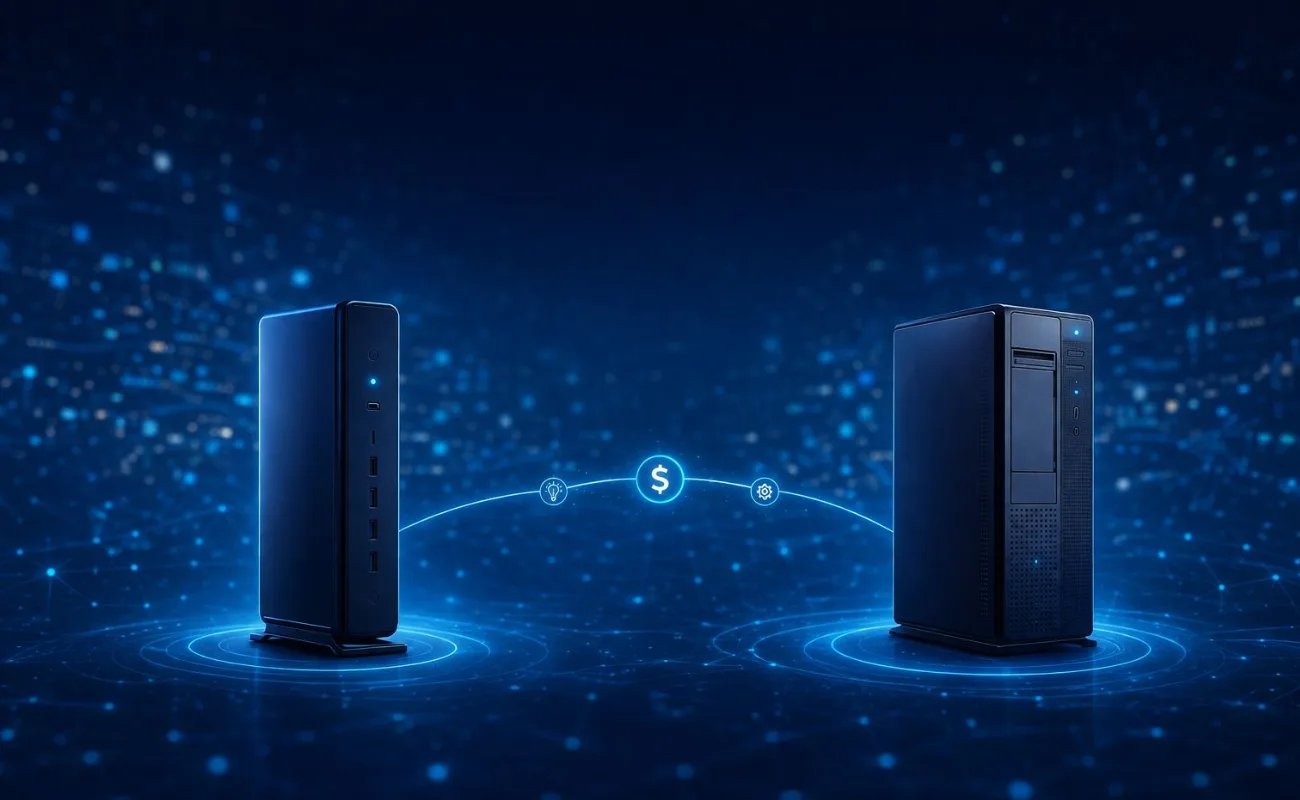
Businesses today are constantly looking for ways to reduce IT costs while maintaining performance and efficiency. One of the most common decisions organizations face is choosing between thin clients and traditional desktop PCs. Understanding Thin Client vs Desktop PC: Which Saves More in the Long Run? is essential for making a cost-effective and scalable IT investment.
Both solutions serve different purposes, and the right choice depends on infrastructure, workload requirements, and long-term operational strategy.
What Is a Thin Client?
A thin client is a lightweight computing device that relies on a centralized server or cloud environment to process data and run applications. Instead of performing tasks locally, it connects to a remote system where all processing happens.
Thin clients are commonly used in environments such as call centers, educational institutions, and enterprises with virtual desktop infrastructure (VDI).
What Is a Desktop PC?
A desktop PC is a standalone computer that performs all processing locally. It includes its own CPU, RAM, storage, and operating system, making it independent of centralized servers.
Desktop PCs are widely used in offices where users require flexibility, offline access, or higher local processing power.
Thin Client vs Desktop PC: Which Saves More in the Long Run?
When comparing Thin Client vs Desktop PC: Which Saves More in the Long Run?, the evaluation goes beyond initial purchase cost. Long-term savings depend on multiple factors, including maintenance, energy consumption, scalability, and management.
Initial Cost Comparison
Thin Clients
- Lower upfront hardware cost
- Minimal local components
- Requires backend server or cloud infrastructure
Desktop PCs
- Higher initial cost per unit
- No dependency on centralized infrastructure
- Full hardware setup included
While thin clients are cheaper per device, organizations must account for server or cloud investment.
Maintenance and IT Management Costs
Maintenance is a key factor in determining Thin Client vs Desktop PC: Which Saves More in the Long Run?
Thin Clients
- Centralized management
- Fewer hardware failures
- Simplified updates and patching
Desktop PCs
- Individual device management
- Higher maintenance effort
- More frequent hardware troubleshooting
Thin clients significantly reduce IT workload and administrative costs.
Energy Consumption and Power Efficiency
Power usage directly impacts long-term operational expenses.
Thin Clients
- Very low power consumption
- Minimal heat generation
- Reduced cooling requirements
Desktop PCs
- Higher power usage
- Increased cooling needs
- Greater energy costs over time
In energy-sensitive environments, thin clients offer clear cost advantages.
Performance and Workload Handling
Performance requirements play a major role in deciding Thin Client vs Desktop PC: Which Saves More in the Long Run?
Thin Clients
- Dependent on server or cloud performance
- Ideal for standard office applications
- Limited for heavy workloads
Desktop PCs
- Strong local processing power
- Suitable for design, engineering, and development
- No dependency on network connectivity
Desktop PCs are better for high-performance tasks, while thin clients suit routine workloads.
Scalability and Deployment
Thin Clients
- Easy to scale by adding users to central infrastructure
- Quick deployment across multiple locations
- Ideal for growing organizations
Desktop PCs
- Requires hardware purchase for each new user
- Slower deployment
- Higher scaling costs
Thin clients provide a more flexible and scalable solution.
Security and Data Protection
Security is another important factor in the comparison.
Thin Clients
- Data stored centrally
- Reduced risk of data loss
- Easier to enforce security policies
Desktop PCs
- Data stored locally
- Higher risk of data breaches or loss
- More complex security management
Thin clients offer stronger centralized security control.
Long-Term Cost Analysis
To fully answer Thin Client vs Desktop PC: Which Saves More in the Long Run?, businesses must consider total cost of ownership (TCO):
Thin Clients
- Lower hardware and energy costs
- Reduced maintenance expenses
- Higher initial infrastructure investment
- Lower long-term operational cost
Desktop PCs
- Higher hardware and energy costs
- Increased maintenance and support expenses
- Lower initial infrastructure complexity
- Higher long-term cost in large environments
For large-scale deployments, thin clients usually provide better long-term savings.
Best Use Cases for Each Solution
Thin Clients Are Ideal For:
- Call centers
- Educational labs
- Remote work environments
- Organizations using VDI or cloud desktops
Desktop PCs Are Ideal For:
- Designers and engineers
- Developers and IT professionals
- High-performance computing tasks
- Offline or independent work environments
Conclusion
When evaluating Thin Client vs Desktop PC: Which Saves More in the Long Run?, the answer depends on business size, workload type, and IT strategy.
- Thin clients offer lower operational costs, easier management, and better scalability
- Desktop PCs provide higher performance and flexibility for demanding tasks
For organizations focused on cost efficiency and centralized management, thin clients often deliver greater long-term savings. However, for performance-intensive workloads, desktop PCs remain the better choice.
Selecting the right solution ensures optimal balance between cost, performance, and future growth.